Off-Grid Solar Inverters
An off-grid inverter turns battery power into household AC for a cabin, shop, homestead or home with no utility connection, or one you don't want to rely on. Choose by battery voltage first (12V, 24V or 48V), then continuous watts and surge, AC output (120V or 120/240V split-phase) and how much solar you plan to connect. Every off-grid inverter we list online today is a 48V RUiXU SUNON all-in-one: a pure sine wave inverter, MPPT solar charger and grid or generator battery charger in one indoor unit.
Read more about Off-Grid Solar Inverters
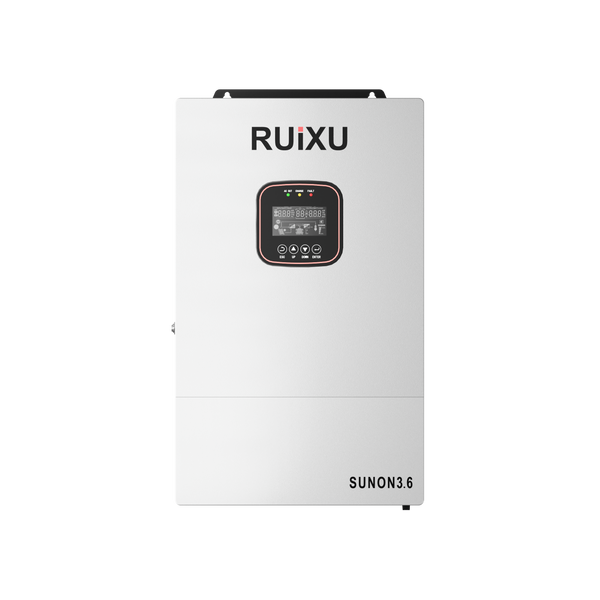
- 120V cabin, shed or shop: RUiXU SUNON3.6: 3,600W rated, 120V, one MPPT with up to 4,500W of solar, 2 HP motor-load rating.
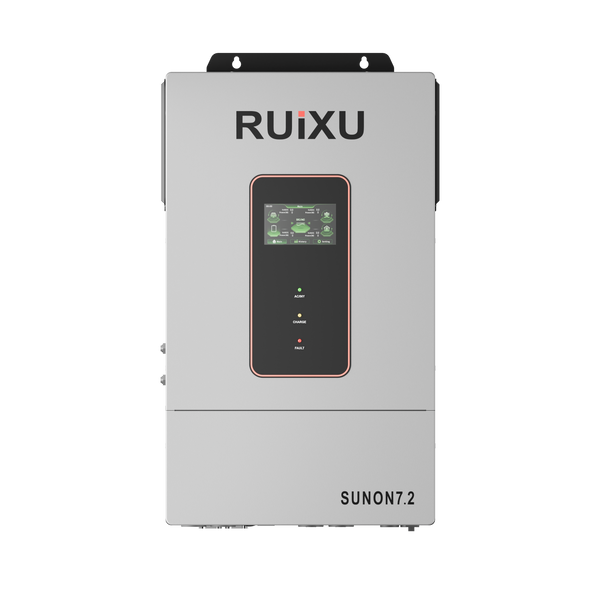
- Off-grid home or cabin that needs 240V: RUiXU SUNON7.2: 7,200W rated, 120/240V split-phase, two MPPTs with up to 4,500W each, 4 HP motor-load rating.
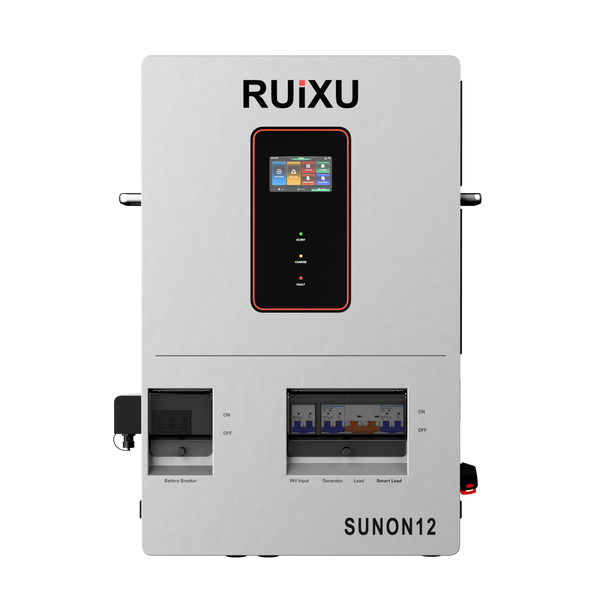
- Larger off-grid home with big motor loads or a generator: RUiXU SUNON12: 12,000W rated, 120/240V split-phase, two MPPTs with up to 12,000W each, 6 HP motor-load rating, and a dedicated generator input.
Need a 12V or 24V inverter, another brand or a complete system design? Request a written quote. Want to sell solar back to the utility? Look at hybrid inverters instead.
- RUiXUSKUSUNON12$2,075.00Available to order Shipping calculated at checkout
- RUiXUSKUSUNON7.2
RUiXU SUNON7.2 7.2kW 48V Off-Grid Inverter, 120/240V Split-Phase
$1,219.00Available to order Shipping calculated at checkout - RUiXUSKUSUNON3.6
RUiXU SUNON3.6 3.6kW 48V Off-Grid Inverter, 120V
$519.00Available to order Shipping calculated at checkout
How to choose an off-grid inverter
- List your loads. Write down the running watts of everything that may be on at the same time, plus the start-up surge of motors such as well pumps, fridges and compressors. A motor can briefly draw several times its running watts. Our off-grid system sizing calculator walks you through a loads list.
- Pick the battery voltage. An off-grid inverter is built for one battery voltage, so decide it before you buy. As a rule of thumb, 12V suits small RV or cabin systems; above roughly 2,000W at a time, 24V or 48V keeps battery current and cable size down; most full-time off-grid homes are best served by 48V. All three SUNON models are 48V units that accept a 40–60V battery.
- Match continuous and surge ratings. The inverter's rated output should cover your continuous load, and its peak and motor ratings must handle start-up surge. RUiXU lists rated watts, maximum VA and a motor-load rating in horsepower for each SUNON model.
- Match the AC output. One SUNON3.6 outputs 120V; RUiXU says two or more paralleled units provide split-phase output. The SUNON7.2 and SUNON12 give 120/240V split-phase from one unit, for 240V loads such as well pumps.
- Check the solar input. Each solar string must stay inside the MPPT voltage range and below the maximum open-circuit voltage at your coldest temperature. See the table below.
- Plan for growth. RUiXU lists up to six SUNON units in parallel; follow RUiXU's manual for parallel setups.
Inverter, inverter-charger or all-in-one?
- Inverter: only converts DC battery power to AC. Battery charging comes from a separate charge controller or charger.
- Inverter-charger: adds an AC input, so grid or generator power can charge the batteries and pass through to your loads. On an off-grid inverter-charger, that AC connection is one-way: it takes power in and does not send power back to the utility.
- All-in-one: an inverter-charger with a built-in MPPT solar charge controller. That is what the SUNON models are, so most systems built around one do not need a separate charge controller.
- Pure sine or modified sine: pure sine wave output matches utility power and suits electronics, motors and most modern appliances. All three SUNON models are pure sine wave. Read more in pure sine vs modified sine inverters.
Compare the SUNON models
| Model | Rated / max output | AC output | Motor load | Solar input | Max solar charging | Built-in breakers |
|---|---|---|---|---|---|---|
| SUNON3.6 | 3,600W / 7,200VA | 120V | 2 HP | 1 MPPT, 4,500W, 90–260 VDC, 300 VDC max | 80A | None listed |
| SUNON7.2 | 7,200W / 10,800VA | 120/240V split-phase | 4 HP | 2 MPPTs, 4,500W each, 90–450 VDC, 500 VDC max | 150A | None listed |
| SUNON12 | 12,000W / 18,000VA | 120/240V split-phase | 6 HP | 2 MPPTs, 12,000W each, 90–450 VDC, 500 VDC max | 250A | Inverter input, generator, load, smart load, battery |
Specs are from RUiXU's SUNON spec sheets. All three are rated IP20 for indoor use only and derate above 45°C (113°F). Check each product page for current details.
What else you need
- A 48V battery bank: browse solar batteries and lithium (LiFePO4) batteries. RUiXU lists lithium-ion, lead-acid and user-defined battery settings, with RS485 and CAN communication. Before pairing a lithium battery, confirm that the battery maker supports the SUNON model and its communication protocol. Our guide to sizing a deep-cycle battery bank helps with capacity.
- Solar panels: solar panels wired in strings that fit the model's MPPT window.
- Protection and wiring: disconnects and breakers, cable and wiring, and our inverter cable, breaker and fuse sizing table. RUiXU lists no built-in breakers on the SUNON3.6 and SUNON7.2. The SUNON12 has several, but local code may still require external disconnects.
- Planning: 6 steps to designing an off-grid solar power system and the off-grid solar parts checklist.
Comparing inverter types? See all solar inverters, including hybrid, grid-tie and microinverters.
Off-grid inverter FAQ
What size off-grid inverter do I need?
Add up the running watts of everything you may use at the same time and choose an inverter whose rated output covers that total with some margin. Then check that its peak and motor ratings can handle start-up surge. Use the off-grid sizing calculator to build your loads list.
Should my system be 12V, 24V or 48V?
Generally, the larger the system, the higher the battery voltage. A 12V bank suits small RV or cabin setups. Above roughly 2,000W at a time, 24V or 48V means less current and thinner cable, and most full-time off-grid homes are best served by 48V. The inverter must match the battery voltage, and the SUNON models we list are 48V.
Do I need a separate charge controller?
Usually not with a SUNON. Each model has built-in MPPT solar charging (80A on the SUNON3.6, 150A on the SUNON7.2 and 250A on the SUNON12). Keep every solar string inside that model's MPPT voltage range.
Can I run a generator with an off-grid inverter?
Yes. On the SUNON models, a generator connected to the AC input can charge the batteries and power loads through the inverter. The SUNON12 has a dedicated generator input separate from its grid input.
Can a SUNON off-grid inverter sell power back to the utility?
Don't plan on it. RUiXU's spec sheets list the SUNON line as all-in-one off-grid inverters, and RUiXU does not describe them as grid-tie inverters, so do not plan on exporting solar power with one. If you want to sell power back to the utility and have battery backup, choose a hybrid inverter.
Can altE help me choose?
Yes. Send us your loads list, battery voltage, AC service (120V or 120/240V) and planned solar array. Request a written quote or use the battery backup system quote request.