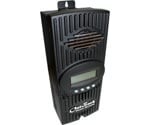
Solar charge controllers are designed to do two main things within a solar power system: optimize the charging of your deep cycle batteries by the solar panels, and prevent electricity stored in the batteries from going through the solar panels when there is no sun.
Many of the solar charge controllers we offer have additional features, including the ability to automatically turn DC-powered loads, such as lights, off or on. Other controllers may be used with strings of solar panels arranged to generate relatively high voltages. Additionally, some can provide monitoring of your batteries' voltage and amp-hours left, and even connect to your home data network for remote monitoring.
Find out the basics of a solar charge controller, what it does, how it works, and how to select the correct size for an off grid solar power system. A charge controller is an important component in a battery based solar system and are not used in straight grid tie systems.
Sizing a Charge Controller
Solar charge controllers are categorized by both amperage and voltage. You will need one that can support the voltage of your solar panel array, and output to the battery bank's voltage (usually 12, 24 or 48VDC).
Be sure to protect this important part of your system with appropriate overcurrent protection before and after the solar controller (see Enclosures, Electrical & Safety for options).
Can you charge a 24V battery with a 20V solar panel and MPPT charge controller?
We compare charging a 24V deep cycle battery bank with a 20V solar panel and a 24V solar panel on a hot summer day with an MPPT charge controller. Because silicon solar panels output a lower voltage in the heat, the voltage output of the solar panels is lower than standard test conditions (STC), so we see if the voltage is high enough to charge the 24V battery bank.
Types of Solar Charge Controllers
MPPT Solar Charge Controllers
The MPPT (Maximum Power Point Tracking) solar charge controller is the shining star of today's solar systems. These controllers actually detect the optimum operating voltage and amperage of the solar panel array and match that with the battery bank. The result is additional 15-30% more power out of your solar array versus a PWM solar controller. Although the MPPT solar charge controller is more expensive than its PWM counterpart, it is generally worth the investment for any solar electric system over 200 Watts.
Make sure the solar charge controller has enough capacity to handle the current (in amps) from your solar panel array. Take the wattage of your solar panels and divide it by the battery bank's voltage to get a rough estimate of how many amps the controller needs.
PWM Solar Charge Controllers
A Pulse Width Modulated (PWM) solar charge controller is the traditional style. They are robust, inexpensive and widely used in solar panel applications. The nominal voltage of the solar array has to match the voltage of the battery bank. For example, a 12V panel must be used with a 12V battery.
The basic formula for sizing one is to take the short circuit current (Isc) of the array and multiply it by 1.25. Be sure that the solar charge controller you select can handle at least that many amps.
What are PWM & MPPT solar charge controllers?
Now that you know what size solar controller to look for, identify which type of solar charge controller is right for your application: MPPT or PWM.
Features and add-ons for Solar Controllers
Once you've decided on a type of solar charge controller, identify what features you need. There are many basic solar charge controllers that work very well, but some have great features that will make your renewable energy experience even better. One important addition to your system is Battery Temperature Sensors. Battery capacity depends on temperature, therefore proper battery charging can be significantly enhanced with a temperature sensor.
Additionally, some solar controllers offer adjustable control voltage set points, low voltage disconnect, overload protection, and metering. If you plan to run a DC load, you can connect it directly to the solar charge controller. If the solar controller is equipped with a low voltage disconnect (LVD), then the solar charge controller can detect when the battery is low and shut off the DC load until the battery is charged.